
Wired vs Wireless Security Systems: What Contractors Should Choose
This is one of the most common questions Illinois contractors ask when they sit down with Sentry Security’s engineering team: should we go wired or wireless? The honest answer is that it depends on your sites — and a qualified engineer should make that recommendation based on your specific operational reality, not a sales incentive.
Here’s the complete breakdown so you go into that conversation educated.
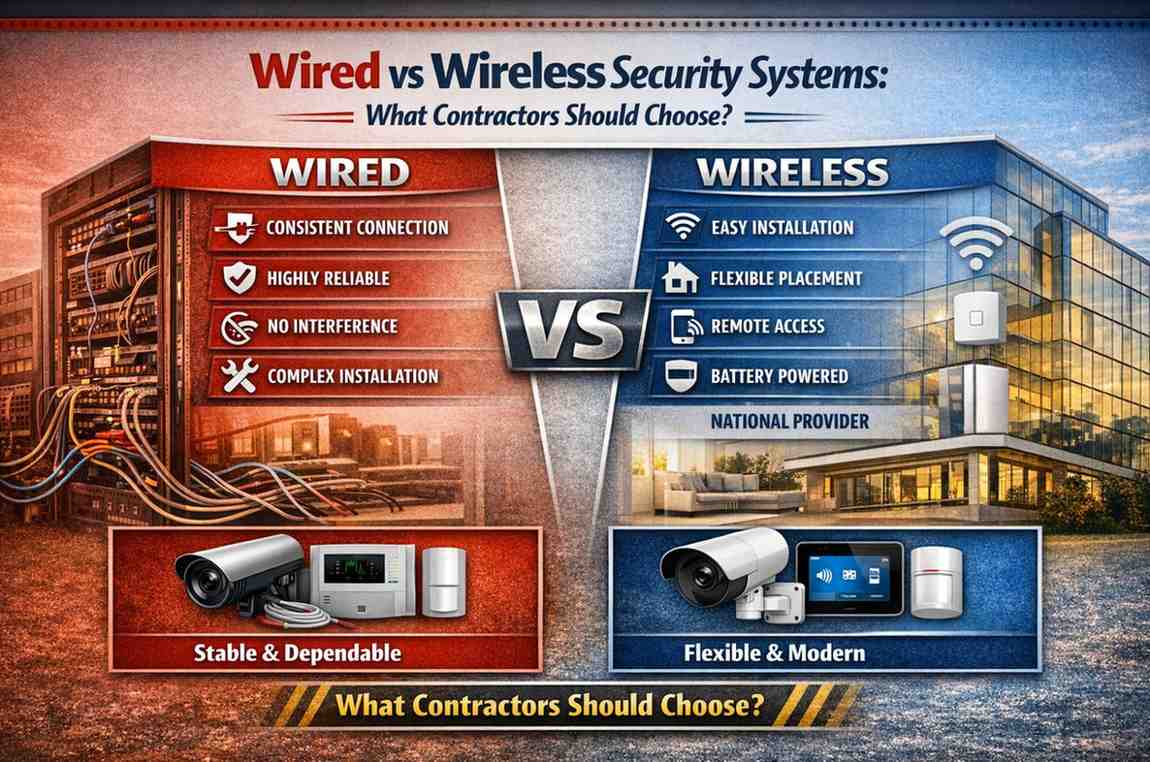
Wired Security Systems: The Permanent Installation Standard
Where Wired Systems Excel
Hardwired security systems run sensor signals, access control, and power through physical cable infrastructure — typically installed in conduit inside walls and ceilings. For permanent commercial buildings that are complete and occupied, wired systems provide:
- Maximum signal reliability — no RF interference, no battery management
- Physically tamper-resistant when installed in conduit
- Lower long-term operating cost once infrastructure is in place
- Preferred for high-security permanent installations: banks, data centers, corrections facilities
Why Wired Falls Short for Active Construction Sites
- Requires infrastructure: conduit runs, junction boxes, wiring chases — in buildings under construction, this adds significant cost and complexity
- Cannot be relocated as site evolves — sensors installed in framing become obstacles during construction progression
- Not practical for temporary facilities: site offices, equipment staging areas, construction trailers
- Installation timelines conflict with contractor project schedules
Wireless Security Systems: Built for the Way Contractors Operate
Why Wireless Wins for Construction and Multi-Site Operations
Sentry Security’s wireless security systems were designed specifically for the way contractors operate. No infrastructure investment. No coordination with the construction schedule. Sensors deploy in hours, not weeks.
- Rapid deployment — systems operational in hours without infrastructure work
- Fully portable and relocatable as construction progresses and sites change
- Cellular backup communication — monitoring operates without wired internet at the site
- Battery-powered sensors with extended life and low-battery alerting
- Scales across multiple sites without rebuilding infrastructure
- Virtual keypad management — full remote control without on-site visits
→ Wireless Security Systems
→ Virtual Keypad Platform
Addressing the Reliability Question
Modern commercial wireless security systems have evolved dramatically. Sentry Security’s wireless platforms use frequency-hopping spread spectrum communication, encrypted transmission protocols, and redundant cellular backup — making them as reliable as wired systems for the vast majority of contractor applications. Battery management has improved to the point where sensor batteries last years, not months, with automated low-battery alerts.
Sentry Security’s Hybrid Approach: The Best of Both
For contractors who are both building and eventually handing over permanent commercial facilities, Sentry Security engineers hybrid systems: wireless sensors during construction phases that integrate into hardwired infrastructure during the building completion phase. The client receives a permanent, fully wired system at handover — with no gap in protection during construction.
This kind of engineering-led, phased approach is only possible with a security partner who has the expertise to design for the entire project lifecycle — not just the moment of installation.
→ System Design & Engineering
→ Integrated Security Systems
FAQs
Are wireless security systems reliable enough for commercial contractor applications?
Yes. Sentry Security’s commercial wireless systems use encrypted frequency-hopping communication and cellular backup — providing monitoring reliability equivalent to wired systems in contractor environments. Their engineering team selects wireless platforms specifically validated for commercial applications.
Can Sentry Security transition a wireless construction site system to a wired permanent installation?
Yes. Sentry Security engineers phased systems designed to transition from wireless construction-phase deployment to hardwired permanent installation at project completion, maintaining security continuity throughout.
What happens if a wireless sensor’s battery dies?
Sentry Security’s wireless sensors include automated low-battery alerts that notify the monitoring center and site manager well before battery failure. Their maintenance program also includes scheduled sensor battery inspection.
🔒 Ready to Experience the Sentry Difference?
Illinois’s most elite commercial security provider is one call away. Don’t settle for second-best when your business, your people, and your assets deserve the absolute finest protection in the industry.