
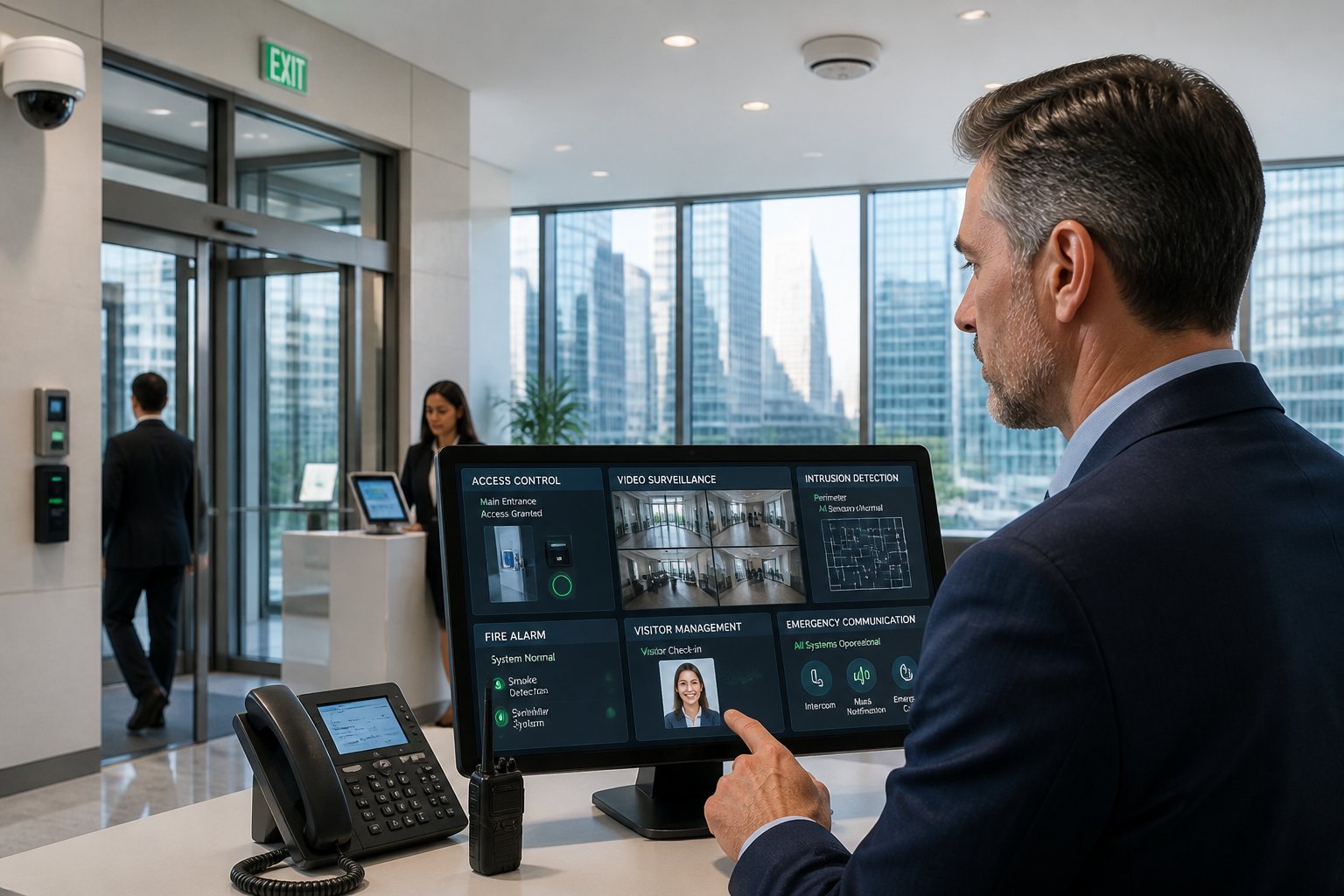
Chicago businesses need security systems that match the way their buildings, employees, customers, visitors, equipment, and operations actually work. For many commercial properties, that means combining access control, video surveillance, intrusion detection, fire alarm systems, visitor management, and emergency communication instead of relying on one standalone security product.
The right combination depends on the type of business, building layout, number of entrances, restricted areas, operating hours, assets being protected, existing infrastructure, and applicable Chicago and Illinois requirements.
In short: A Chicago business should start with a security assessment that identifies its most important entry points, vulnerable areas, life-safety requirements, after-hours risks, and operational needs. The resulting system should be designed as an integrated security strategy rather than simply adding cameras or alarms.
Quick Answer: Common commercial security systems for Chicago businesses include access control, IP video surveillance, intrusion detection, fire alarm and life-safety systems, visitor management, emergency communication, and remote security management. Not every business needs every system, so the right solution should be based on the property and its specific risks.
What Security Systems Do Chicago Businesses Commonly Use?
Commercial security is usually made up of several systems, each addressing a different part of the security environment.
| Security System | What It Does | Common Chicago Business Uses |
|---|---|---|
| Access Control | Controls who can enter specific doors or areas | Offices, warehouses, healthcare, multifamily, schools, industrial facilities |
| Video Surveillance | Provides visual monitoring and recorded evidence | Entrances, parking areas, loading docks, retail, offices, warehouses |
| Intrusion Detection | Detects unauthorized entry or activity | Commercial buildings, warehouses, retail, industrial properties |
| Fire Alarm Systems | Detects and communicates fire emergencies | Commercial and regulated occupancies |
| Visitor Management | Controls and documents visitor access | Office buildings, healthcare, schools, corporate facilities |
| Emergency Communication | Helps communicate during emergencies | Campuses, schools, healthcare, large commercial facilities |
| Remote Security Management | Allows authorized personnel to manage security remotely | Multi-location businesses and distributed facilities |
The value comes from determining which technologies are appropriate and then making those systems work together where integration provides a practical benefit.
1. Access Control for Chicago Businesses
Access control determines who is authorized to enter a building, room, floor, gate, or other restricted area.
Modern commercial access control can use:
- Key cards
- Proximity credentials
- Mobile credentials
- PINs and keypads
- Electronic locks
- Biometric authentication
- Gate access systems
- Cloud-managed access control
This becomes particularly useful when a business has different levels of access.
For example, employees may need access to the main office but not a server room. A facility manager may need access to mechanical areas. A contractor may need temporary access to a particular location during a defined period.
Instead of giving everyone a physical key, access control allows permissions to be assigned and managed according to the person’s role.
Sentry Security’s integrated security approach specifically combines access, intrusion, and video systems for commercial properties, including manufacturing, warehouse, distribution, industrial, and corporate facilities.
2. Video Surveillance for Chicago Commercial Properties
Video surveillance gives businesses visibility into activity around and inside their facilities.
Depending on the property, cameras may be positioned at:
- Main entrances
- Employee entrances
- Parking lots
- Parking garages
- Loading docks
- Shipping and receiving areas
- Cash-handling areas
- Inventory areas
- Hallways and common areas
- Restricted areas
- Building perimeters
Sentry Security’s commercial video solutions include indoor and outdoor cameras, IP and CCTV systems, thermal perimeter detection, analytics, remote access, storage options, and integration with video, audio, alarm, and access-control systems.
The number of cameras a business needs depends on the property layout and the purpose of the surveillance. Camera placement, viewing angles, lighting, image requirements, storage, and coverage objectives all matter.
More cameras do not automatically mean better security. A properly designed system should focus on the areas where video provides the most useful security and operational information.
3. Intrusion Detection for Chicago Businesses
Intrusion detection is designed to identify unauthorized entry or movement in protected areas.
Depending on the facility, an intrusion system can include:
- Door contacts
- Window contacts
- Motion detectors
- Glass-break detection
- Perimeter detection
- Panic or duress devices
- Alarm panels
- Audible and visual notification
- Professional monitoring
Intrusion protection can be particularly important for businesses that have valuable inventory, sensitive information, expensive equipment, restricted areas, or facilities that remain unoccupied during portions of the day.
A warehouse, for example, may need protection at employee entrances, loading areas, exterior doors, inventory areas, and other vulnerable locations rather than relying on a single alarm device at the front entrance.
4. Commercial Fire Alarm Systems in Chicago
Fire and life-safety systems are a separate but critical component of commercial building protection.
Fire alarm requirements depend on factors such as occupancy, building characteristics, applicable codes, existing systems, and the specific use of the property.
Chicago’s Building Code includes requirements for approved fire alarm systems in specified occupancies. Chicago’s fire-protection provisions also incorporate requirements relating to fire alarm design, construction documents, shop drawings, NFPA 72, notification appliances, and other system elements.
That means a Chicago business should not select a fire alarm system solely by comparing equipment prices. The system needs to be appropriate for the property and applicable requirements.
For any project involving fire alarm compliance, businesses should verify the current requirements applicable to their specific building and occupancy with the appropriate authorities and qualified professionals.
5. Visitor Management for Chicago Businesses
A business may have excellent access control and still have a visitor-management problem.
Customers, vendors, contractors, delivery personnel, applicants, patients, and other visitors may enter a facility every day. A visitor management system can help organizations control and document that activity.
Depending on the system, visitor management can help businesses:
- Register visitors
- Issue temporary credentials
- Track contractors and vendors
- Control visitor access
- Maintain visitor records
- Identify visitors during an emergency
- Connect visitor activity with access-control processes
This is especially useful for office buildings, healthcare facilities, schools, corporate campuses, and multi-tenant properties.
6. Emergency Communication and Notification
Commercial security is not only about preventing unauthorized access. Businesses also need effective ways to communicate when an emergency occurs.
Depending on the facility, emergency communication may be relevant to:
- Fire emergencies
- Security incidents
- Severe weather
- Building evacuations
- Medical emergencies
- Unauthorized access
- Other critical incidents
Large buildings, schools, healthcare facilities, campuses, and multi-building organizations may have significantly different emergency communication requirements from a small professional office.
7. Remote Security Management
Businesses with multiple locations often need security information without physically visiting each property.
Depending on the platform, authorized users may be able to:
- View security cameras remotely
- Manage access credentials
- Review security events
- Receive alerts
- Check system status
- Manage multiple facilities
Sentry Security specifically describes its ability to centrally integrate multi-site facilities and buildings and provide remote interactive connectivity for commercial security environments.
How Do You Know Which Security Systems Your Chicago Business Needs?
The right starting point is not a product catalog. It is an assessment of the property.
A commercial security assessment should consider:
- Entrances and exits: How many doors, gates, and other entry points require protection?
- Restricted areas: Which rooms or spaces should have limited access?
- Operating schedule: Is the property occupied 24/7 or left unattended after hours?
- People: How many employees, visitors, contractors, and customers use the building?
- Assets: What inventory, equipment, information, or property requires protection?
- Existing technology: What systems are already installed?
- Life safety: What fire and emergency systems apply to the property?
- Integration: Which systems should communicate with each other?
- Growth: Can the system expand if the organization adds employees, doors, buildings, or locations?
This approach can prevent two common problems: buying too little security for the actual risk or spending money on technology that does not solve the property’s most important security problems.
What Security Systems Does a Chicago Office Building Need?
A commercial office building may need a combination of access control, video surveillance, intrusion detection, visitor management, fire and life-safety systems, and emergency communication.
For a multi-tenant building, the design may need to distinguish between:
- Building entrances
- Tenant entrances
- Common areas
- Mechanical rooms
- Server rooms
- Parking facilities
- Loading areas
- Management offices
Access permissions can then be structured around tenants, employees, management, contractors, and other authorized users.
What Security Systems Does a Chicago Warehouse Need?
Warehouses typically present a different security environment from office buildings.
Important areas can include:
- Loading docks
- Roll-up doors
- Employee entrances
- Shipping and receiving areas
- Inventory storage
- Parking lots
- Exterior perimeters
- Equipment areas
A warehouse security strategy may combine access control, video surveillance, intrusion detection, remote management, and appropriate fire and life-safety systems.
The objective is to control access while also creating visibility into what happens around critical areas.
What Security Systems Does a Chicago Retail Business Need?
Retail businesses may need security solutions focused on entrances, employee areas, inventory, cash-handling locations, parking areas, and after-hours protection.
Depending on the business, the system may include:
- Video surveillance
- Intrusion detection
- Employee access control
- Remote video access
- Alarm monitoring
- Emergency or panic devices
Some Illinois industries can also have additional statutory security requirements. For example, Illinois State Police materials describe specific alarm and video-surveillance requirements applicable to certified firearm retailers.
What Security Systems Does a Chicago Healthcare Facility Need?
Healthcare facilities have a particularly complex security environment because they need to balance patient access, employee safety, restricted areas, visitors, medications, records, equipment, and emergency response.
Depending on the facility, security planning may involve:
- Controlled employee access
- Visitor management
- Video surveillance
- Restricted-area access
- Duress or emergency devices
- Intrusion detection
- Fire and life-safety systems
- Emergency communication
The system should support the facility’s operational requirements without creating unnecessary barriers for patients, authorized staff, or emergency personnel.
Can Access Control, Cameras, and Intrusion Systems Work Together?
Yes. Integrating security technologies can provide more useful information than operating each system independently.
For example, an access-control event can be associated with video from the same entrance. An intrusion alarm can generate an event while cameras provide visual context. Security personnel can then evaluate more information about what happened instead of receiving only an isolated alarm notification.
Sentry Security describes integrated systems combining video, intrusion, and access technologies, with the goal of improving security visibility, operational efficiency, and incident documentation.
How Much Does a Commercial Security System Cost in Chicago?
There is no meaningful single price for a commercial security system because the scope can vary dramatically between properties.
Important cost factors include:
- Building size
- Number of protected doors
- Number and type of cameras
- Access-control hardware
- Intrusion devices
- Fire alarm requirements
- Video storage
- Monitoring
- System integration
- Existing wiring and infrastructure
- Installation complexity
- Ongoing service and maintenance
A small office and a large warehouse should not be expected to require the same security budget.
The most accurate approach is to define the security objectives, assess the property, determine the required equipment and integration, and then develop a project-specific scope.
Chicago Commercial Security Checklist
Before selecting a commercial security system, a Chicago business can review the following:
- Identify every exterior entrance and exit.
- Identify employee-only entrances.
- Identify restricted rooms and areas.
- Identify valuable equipment and inventory.
- Review parking and exterior areas.
- Review loading and delivery areas.
- Determine where video surveillance is needed.
- Determine which doors require controlled access.
- Review the existing intrusion system.
- Review fire alarm and life-safety systems.
- Determine whether visitor management is necessary.
- Evaluate emergency communication needs.
- Determine whether remote management would improve operations.
- Determine which systems should be integrated.
- Plan for future expansion.
Common Mistakes Chicago Businesses Make When Choosing Security Systems
Choosing cameras before identifying security risks
A business may immediately focus on buying cameras without determining which areas actually require coverage or what the cameras need to accomplish.
Giving too many people unrestricted access
When every employee receives the same access permissions, the business may lose control over restricted areas. Role-based access can provide more precise control.
Using disconnected security systems
Separate systems can create unnecessary operational complexity. Integration may allow access events, video, intrusion alarms, and other security information to work together.
Ignoring after-hours security
A property can be well controlled during business hours and still have significant vulnerabilities when employees leave.
Planning only for today’s building
Businesses grow. They add employees, doors, locations, equipment, and sometimes entire facilities. Security infrastructure should be evaluated for future expansion.
What Should You Look for in a Chicago Commercial Security Company?
A commercial security provider should be able to understand the facility before recommending technology.
Important questions include:
- Can the provider design an integrated system?
- Can it work with existing security equipment?
- Does it support access control and video integration?
- Can the system scale to additional locations?
- Does the provider offer ongoing service and maintenance?
- Can the provider explain how the system will operate after installation?
- Does the proposed system address the actual risks identified during the assessment?
Sentry Security describes itself as a life-safety and integrated-security provider with more than 35 years of experience in access control, burglar and fire alarm systems, and video surveillance. Its commercial offerings include integrated security systems, video surveillance, intrusion detection, access control, and related services.
Why an Integrated Security Assessment Is the Better Starting Point
A professional security assessment should not simply produce a list of equipment.
It should answer four fundamental questions:
- What needs to be protected?
- What are the most important vulnerabilities?
- How should the security system respond to those vulnerabilities?
- How should the individual security technologies work together?
For one Chicago business, the biggest problem may be an unsecured employee entrance. For another, it may be poor visibility around a loading dock. Another may need better control over contractors and visitors. A healthcare facility may have entirely different priorities.
That is why an integrated assessment is more useful than simply selecting the same security package for every property.
Frequently Asked Questions About Chicago Business Security
What security systems does a Chicago business need?
Common commercial security systems include access control, video surveillance, intrusion detection, fire alarm systems, visitor management, emergency communication, and remote security management. The appropriate combination depends on the building, business type, security risks, and applicable requirements.
What is the most important security system for a Chicago business?
There is no single system that is best for every business. Access control, video surveillance, intrusion detection, fire protection, and emergency communication address different risks. The correct priority depends on the property.
How many security cameras does a Chicago business need?
The number depends on the building layout, areas requiring coverage, lighting, camera capabilities, image requirements, storage, and the purpose of the surveillance. A security assessment should determine camera placement rather than choosing a number first.
Should a Chicago business use access control and security cameras together?
In many commercial environments, yes. Access control determines who can enter while video surveillance can provide visual information about activity. Integration can make the two systems more useful together.
How much does commercial security cost in Chicago?
Cost depends on the size and complexity of the property, number of doors and cameras, security equipment, monitoring, integration, installation requirements, existing infrastructure, and ongoing service needs. A property-specific assessment is necessary for an accurate project scope.
Do Chicago businesses need fire alarm systems?
Fire alarm requirements depend on the building and occupancy. Chicago’s code contains fire alarm requirements for specified occupancies and building conditions. Businesses should verify the current requirements applicable to their specific property and occupancy.
Can commercial security systems be managed remotely?
Many modern commercial systems support remote management. Depending on the technology, authorized users may be able to review video, manage credentials, receive alerts, check system status, and manage multiple locations.
How can a Chicago business improve security without replacing everything?
Start by evaluating the existing system. In some cases, existing cameras, access-control hardware, alarms, wiring, or infrastructure can be incorporated into a broader upgrade. The best approach depends on the age, compatibility, condition, and capabilities of the existing equipment.
What is an integrated commercial security system?
An integrated security system connects multiple security technologies so they can share information or be managed together. Common integrations include video surveillance, access control, and intrusion detection.
Chicago Business Security: The Bottom Line
The right security system for a Chicago business is not necessarily the system with the most cameras, the most sensors, or the longest equipment list.
The right system is the one designed around the property’s actual security risks and operational requirements.
Access control can help determine who enters. Video surveillance can provide visibility. Intrusion detection can identify unauthorized activity. Fire alarm systems can support life safety. Visitor management can improve control over guests and contractors. Emergency communication can help organizations communicate during critical events.
When these technologies are properly planned and integrated, they can create a more comprehensive commercial security environment.
For a Chicago business considering a new security installation, replacing outdated equipment, expanding to another facility, or integrating multiple security systems, the appropriate first step is a professional assessment of the property and its objectives.
Need Help Choosing Security Systems for Your Chicago Business?
Sentry Security can evaluate your facility, existing systems, security priorities, and operational requirements to help determine an appropriate integrated security solution.
Chicago Commercial Security Resources
Chicago Building Code: Chicago’s official code contains requirements governing fire alarm systems in specified occupancies and buildings. Chicago Fire Alarm and Detection Systems.
Chicago Fire Protection Requirements: Chicago’s code also provides requirements for approved fire alarm systems in specified occupancies. Chicago Standard Fire Alarm System Requirements.
Sentry Security Video Solutions: Sentry Security provides commercial video solutions including IP video, CCTV, analytics, remote access, storage, and integration capabilities. Sentry Security Video & Intercom Systems.
Sentry Security Integrated Systems: Sentry Security describes integrated intrusion, access, and video solutions for commercial, industrial, warehouse, distribution, manufacturing, and corporate environments. Integrated Security Systems.
About This Chicago Security Guide
This guide is intended to help Chicago business owners, facility managers, property managers, and operations teams understand the major components of commercial security planning. Security requirements vary by property, occupancy, industry, and applicable regulations. Regulatory and life-safety requirements should be verified for the specific facility before making design or compliance decisions.