
A Chicago facility manager’s guide to choosing the right biometric access control system with real-world comparisons, cost breakdowns, and industry-specific recommendations from Illinois’ most experienced security integrator.
Quick Answer: Fingerprint recognition offers high accuracy at lower per-door cost ideal for single-door access points like server rooms, pharmacies, and cannabis dispensaries. Facial recognition enables touchless, high-speed identification at scale perfect for building lobbies, hospital entrances, and multifamily residential buildings. Many Chicago-area facilities deploy both technologies in a layered biometric security strategy. Call 847.353.7200 for a free biometric assessment.
The Growing Access Control Problem in Chicago Facilities
Stolen keycards. Shared PIN codes. Tailgating through propped-open doors. For facility managers across Chicago and the greater Illinois area, traditional access control methods are failing to keep pace with evolving security threats.
According to industry data, over 34% of unauthorized building entries trace back to compromised credentials lost key fobs, duplicated access cards, or PIN codes shared among unauthorized individuals. The cost goes far beyond theft: liability exposure, compliance violations, and eroded trust among tenants, patients, and employees are mounting every quarter.
For Chicago-area businesses from Loop high-rises to suburban healthcare campuses and industrial facilities the question is no longer whether to upgrade to biometric access control. It’s which biometric technology fits your facility best.
Biometric systems eliminate these vulnerabilities entirely. Instead of something you carry or remember, they authenticate who you are using unique physical characteristics that can’t be shared, stolen, or forgotten. When integrated with your existing intrusion detection and video surveillance, biometrics create an access control layer that’s virtually impossible to defeat.
Understanding Fingerprint Recognition Systems
How Fingerprint Recognition Works
Fingerprint readers capture and store a digital template of your unique ridge patterns, minutiae points, and whorl characteristics. When an authorized person places their finger on the scanner, the system matches the live scan against stored templates in under one second.
Modern fingerprint systems have evolved far beyond the unreliable optical scanners of the early 2000s. Today’s capacitive and multispectral sensors read beneath the skin’s surface, defeating fake prints and working reliably even with wet, dry, or worn fingertips essential for industrial environments and commercial buildings.
Advantages
- High accuracy: False acceptance rates below 0.001%
- Cost-effective: Lower per-reader hardware cost vs. facial recognition
- Proven technology: Decades of deployment data across industries
- Compact form factor: Fits beside any door frame or turnstile
- Lighting independent: Not affected by ambient light conditions
Limitations
- Requires physical contact (hygiene concern in healthcare and food service)
- Throughput limited to one person at a time
- Can struggle with severe skin damage or certain skin conditions
- Enrollment requires each individual to scan fingers manually
Best Fit For
Server rooms and data centers, cannabis dispensaries, pharmacies, individual office suites, restricted hospital zones, jewelry stores and high-value retail, and correctional facilities.
Understanding Facial Recognition Systems
How Facial Recognition Works
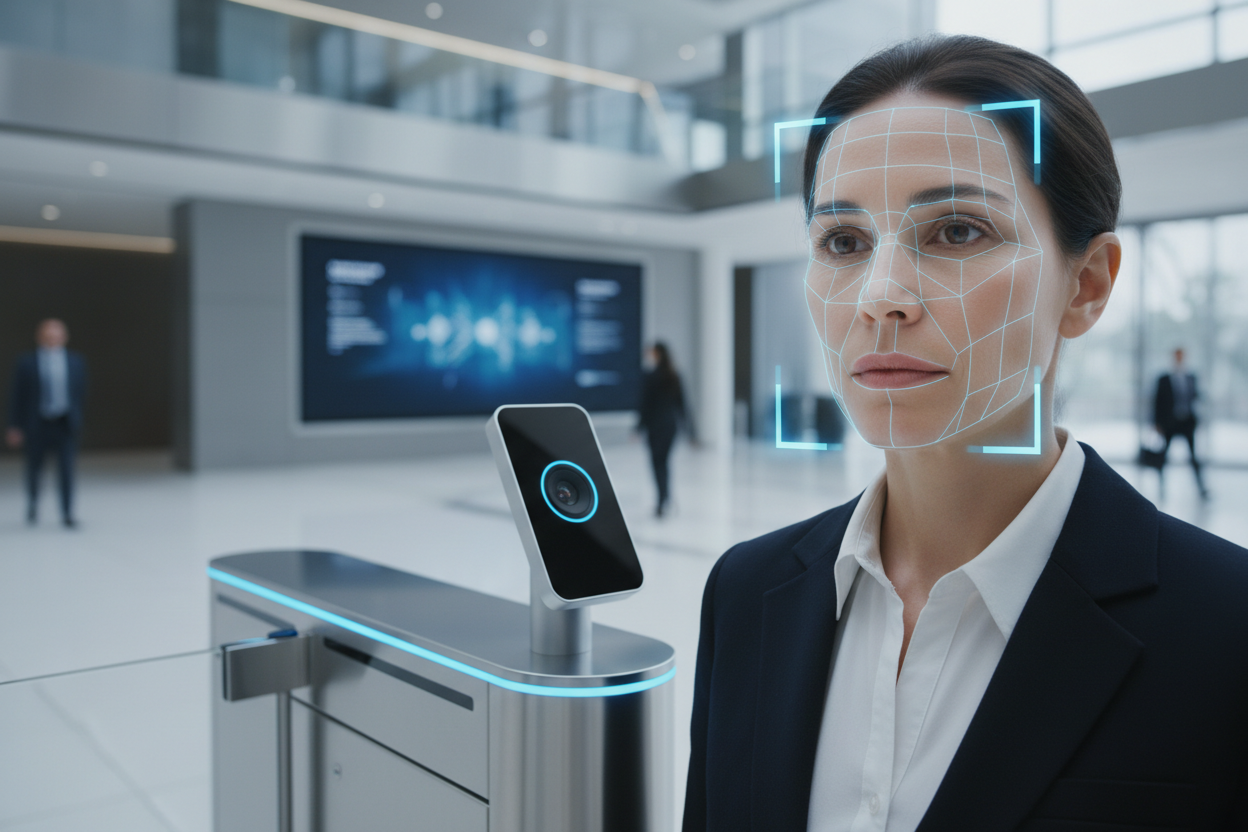
Facial recognition systems use AI-powered cameras to map the geometry of a person’s face measuring the distance between eyes, nose shape, jawline contour, and dozens of other unique facial landmarks. Advanced systems create a 3D depth map that works regardless of angle, expression, or whether the person is wearing glasses.
When integrated with your existing video surveillance infrastructure, facial recognition transforms passive cameras into active access control tools. Known personnel are granted entry automatically. Unknown individuals trigger alerts to your security team in real time through remote access management platforms.
Paired with thermal camera technology, facial recognition can also screen for elevated body temperatures a feature that became standard in healthcare and senior care facilities post-pandemic.
Advantages
- Completely touchless: Zero physical contact required
- High throughput: Can identify multiple people simultaneously
- Video integration: Leverages existing camera infrastructure
- Real-time alerts: Flags unknown individuals instantly
- Remote management: Monitor and control from anywhere via smart building systems
Limitations
- Higher initial hardware cost per access point
- Performance can vary in extreme lighting or weather conditions
- Privacy regulations (Illinois BIPA) require additional compliance steps
- Requires adequate camera positioning and lighting infrastructure
Best Fit For
Building lobbies and main entrances, hospitals and healthcare campuses, multifamily residential communities, casinos and gaming facilities, banking and financial institutions, and education campuses.
Head-to-Head: Fingerprint vs. Facial Recognition
| Feature | Fingerprint | Facial Recognition |
|---|---|---|
| Authentication Speed | Under 1 second | Under 0.5 seconds |
| False Acceptance Rate | Under 0.001% | Under 0.01% |
| Physical Contact Required | Yes | No (touchless) |
| Multi-Person Detection | No | Yes |
| Works in All Lighting | Yes | Requires adequate light |
| Hygiene Factor | Low (contact) | High (touchless) |
| Avg. Hardware Cost Per Door | $$ | $$$ |
| Video System Integration | Limited | Full |
| Best for Throughput | Low to Medium | High |
| Enrollment Complexity | Moderate | Low |
| Outdoor Reliability | High | Moderate to High |
Choose Fingerprint When:
- Budget is a primary consideration
- You need single-door access control
- Environment is indoor with controlled conditions
- Maximum accuracy is required (server rooms, vaults)
- You’re securing fewer than 20 entry points
Choose Facial Recognition When:
- Touchless operation is required (healthcare, food service)
- High foot traffic demands rapid throughput
- You want to integrate with existing video surveillance
- Remote monitoring and management are priorities
- Multi-building or campus-wide deployment is needed
Many of Sentry Security’s Chicago-area clients use both technologies in a layered approach fingerprint at high-security interior doors and facial recognition at primary entrances. Our system design and engineering team will recommend the optimal configuration for your facility.
Which Biometric System Is Right for Your Industry?
Sentry Security serves 18+ industries across Chicago and Illinois. Here are our recommendations based on 35+ years of field experience.
| Industry | Recommended System | Notes |
|---|---|---|
| Commercial Buildings | Both | Facial recognition at lobbies, fingerprint at server rooms |
| Multifamily Residential | Facial | Touchless tenant entry |
| Banking and Finance | Both | Fingerprint for vaults, facial for branches |
| Senior Care | Facial | Touchless, accessible entry |
| Municipalities and Parks | Fingerprint | Secure government buildings |
| Casinos and Gaming | Facial | Floor-wide identity verification |
| Healthcare | Facial | Touchless plus thermal screening |
| Cannabis | Fingerprint | Compliance-grade secure zones |
| Education | Facial | Campus-wide entry management |
| Sports and Leisure | Facial | High-throughput entry gates |
| Hospitality | Facial | Guest-friendly, touchless access |
| Religious Institutions | Fingerprint | Restricted administrative areas |
| ITS and Transportation | Both | Layered transit security |
| Industrial | Fingerprint | Rugged, high-security environments |
| High-Value Business | Both | Vault plus showroom layered security |
| Not-for-Profit | Fingerprint | Budget-conscious organizations |
| Corrections | Fingerprint | Maximum-security authentication |
| Retail | Both | Fingerprint for back-of-house, facial at entrances |
Real Results from Chicago-Area Facilities
Luxury Retail: Eliminating Credential Sharing
A high-profile Chicago jewelry retailer experienced repeated unauthorized access from shared employee PINs. Sentry Security deployed fingerprint readers at every restricted entry point the vault room, back-of-house inventory areas, and the main store entrance after hours.
- 100% elimination of credential sharing
- 47% reduction in after-hours security incidents
- Full audit trail of every access event
- Seamless integration with existing intrusion detection
Read the C.D. Peacock Case Study
Healthcare Campus: Touchless Access at Scale
A major healthcare system serving the western Chicago suburbs needed to secure 12 buildings across their campus without slowing down clinical staff. Sentry Security designed a facial recognition system integrated with their existing video surveillance and visitor management platform.
- 3-second average entry time (down from 8+ seconds)
- 62% improvement in visitor management efficiency
- Full HIPAA-compliant access logging
- Real-time alerts for unauthorized zone entries
Why Chicago Trusts Sentry Security
Over 35 years of protecting Illinois businesses. The largest locally-owned security company in the greater Chicago area. Our average customer relationship spans 12+ years because we get it right.
- 900+ Buildings Serviced across the greater Chicagoland area
- 35,000+ Doors Controlled, including biometric-secured entry points
- 20,000+ Cameras Installed, integrated with access control systems
- 93.1% Customer Retention Rate over 12+ year average relationships
- 7,000+ Alarm Systems Installed
- 35+ Years of Experience – Award-winning team
Frequently Asked Questions
What is the cost difference between fingerprint and facial recognition systems?
- Fingerprint readers carry a lower per-door hardware cost, making them the preferred choice for budget-conscious deployments or facilities with a high number of single-door access points. Facial recognition systems require a higher upfront investment per access point but offer greater throughput, touchless operation, and deeper integration with video surveillance infrastructure. Total cost depends on the number of access points, existing infrastructure, and whether you choose a capital purchase or a Security-as-a-Service model.
Can fingerprint and facial recognition systems work together?
- Yes. Many Sentry Security clients deploy both technologies in a layered strategy facial recognition at primary building entrances for high-throughput touchless access and fingerprint readers at high-security interior zones such as server rooms, vaults, or restricted storage areas. Both systems can be managed from a single centralized dashboard via our integrated security platform.
Which biometric is more secure fingerprint or facial recognition?
- Both offer significantly higher security than card-based or PIN-based systems. Fingerprint systems have a lower false acceptance rate (under 0.001% vs. under 0.01% for facial recognition), making them the preferred choice for maximum-security applications. Multi-modal systems combining both modalities reduce false acceptance rates to near zero.
Do biometric systems work in outdoor environments?
- Fingerprint readers with capacitive or multispectral sensors perform reliably outdoors across a wide range of temperatures and weather conditions. Facial recognition systems require adequate lighting and can be affected by extreme glare or precipitation, though modern systems include environmental compensation features. Sentry Security’s engineering team will assess outdoor installation requirements before recommending a specific system.
How long does biometric system installation take?
- A single-door fingerprint installation can be completed in a few hours. A multi-building facial recognition deployment with full video integration typically takes several days to weeks. Sentry Security provides a detailed project timeline as part of every free security assessment.
Are biometric systems compliant with Illinois BIPA (Biometric Information Privacy Act)?
- Yes, when properly implemented. Illinois BIPA requires organizations that collect biometric data to obtain informed written consent, publish a data retention policy, and prohibit the sale or unauthorized disclosure of biometric identifiers. Sentry Security’s implementation process includes BIPA compliance documentation as a standard component of every biometric deployment in Illinois.
Can biometric access control integrate with my existing security system?
- Yes. Sentry Security specializes in integrated security systems that connect biometric readers with IP cameras, intrusion detection, visitor management platforms, fire alarm systems, and smart building controls all managed from a single dashboard.
What happens if the biometric system goes down?
- Enterprise biometric systems include failover protocols such as PIN backup entry, administrator override, or offline authentication using locally stored templates. Sentry Security’s 24/7 monitoring team is alerted immediately to any system fault and dispatches support as needed.
How does Sentry Security handle biometric data privacy and storage?
- During enrollment, raw biometric images are converted into encrypted mathematical templates and immediately discarded. Only the template is retained never the original scan. Templates are stored locally on the reader, on a secure on-premises server, or in an encrypted cloud environment depending on client preference and compliance requirements. Learn more about Sentry’s security philosophy.
What areas in Illinois does Sentry Security serve?
- Sentry Security serves all of greater Chicago and Illinois, including the Loop, Naperville, Schaumburg, Oak Brook, Downers Grove, Rosemont, Joliet, Elgin, Waukegan, and surrounding suburbs. Contact us to confirm service availability for your location.
Ready to Secure Your Facility with Biometrics?
Your current credential system has a vulnerability you haven’t found yet. Let’s find it before someone else does.
Sentry Security designs, installs, and monitors biometric access control systems for commercial buildings across Illinois. Get a free, no-obligation security assessment today.
Request Free Assessment | Call 847.353.7200 | service@sentrysecurity.com